Love
Mind Your Mind: You Will Take It With You
“[Physical qualities] cannot be carried over into the next life.
The continuum of the mind, however, does carry on.
Therefore, a quality based on the mind is more enduring. …
So, through training the mind, qualities such as compassion, love, and the wisdom [of] realizing emptiness can be developed.”
~ H.H. Dalai Lama
Mind Your Mind: You Will Take It With You
My friend Konrad’s beloved mother used to say:
“If I can’t take it with me, I refuse to go.”
Despite her protestations – like every other person in the history of humanity – she was obliged to leave this world without taking with her anything fiscal or physical.
But her wonderful sense of humor survived her departure.
In this phenomenal world, everything’s energy; our worldly life-forms are but gross and subtle energy vortices in a field of universal awareness.
As the Dalai Lama observes, our subtle mental forms survive the death of our dense physical forms. So when we leave our physical body, our mind persists – and we will take it with us – somewhere.
Thus it’s wise for us to prepare for future ‘mind trips’ by training and stilling our mind to cultivate compassion, love and wisdom, with a wonderful sense of humor –
NOW.
The Circle Around the Zero ~ by Rumi
“Your task is not to seek for love,
but merely to seek and find all the barriers within yourself
that you have built against it.”
~ Rumi
“When you do things from your soul,
you feel a river moving in you,
a joy.”
~ Rumi
“I have lived on the lip
of insanity,
wanting to know reasons,
knocking on a door.
It opens.
I’ve been knocking from the inside.”
~ Rumi

The Circle Around the Zero ~ by Rumi
A lover doesn’t figure the odds.
He figures he came clean from God
as a gift without a reason,
so he gives without cause
or calculation or limit.
A conventionally religious person
behaves a certain way
to achieve salvation.
A lover gambles everything, the self,
the circle around the zero!
He or she cuts and throws it all away.
This is beyond any religion.
Lovers do not require from God any proof,
or any text, nor do they knock on a door
to make sure this is the right street.
They run,
and they run.
~ Rumi
Translation: Coleman Barks, Feeling the Shoulder of the Lion
Pilgrimage to Assisi : Communing With Saint Francis ~ Ron’s Memoirs
“All the darkness in the world cannot extinguish the light from a single candle.”
~ St. Francis Of Assisi (The Little Flowers of St. Francis of Assisi)
“If you have men who will exclude any of God’s creatures from the shelter of compassion and pity, you will have men who will deal likewise with their fellow men.”
~ St. Francis of Assisi
“The deeds you do may be the only sermon some persons will hear today”
~ St. Francis Of Assisi
Pilgrimage to Assisi: Communing With Saint Francis
Introduction
On moving from Chicago to San Francisco in 1960, I knew virtually nothing about saints and was largely uninformed about religions other than Judaism. Even though Saint Francis of Assisi was patron saint of my new home town, I remained ignorant of his life story until after my profound spiritual opening in 1976.
Then, about two years before meeting my Guruji, Shri Dhyanyogi Madhusudandas, I began having synchronistic inner and outer experiences concerning Saint Francis of Assisi, of whom I was previously ignorant. Because of those experiences I developed deep affinity with and great curiosity about this legendary saint, and regarded Saint Francis as an archetype to be emulated.
Soon I began and have ever since continued daily recitations of the “make me an instrument of Thy peace” prayer associated with him. But I was unable to satisfy my curiosity about Saint Francis until ten years after to my 1982 pilgrimage to India. Then on retirement from legal practice in 1992, I made pilgrimages to India and later to Italy to honor my beloved Guruji and ‘Francesco’.
In spring 1992, I journeyed to the Umbrian town of Assisi, Italy, where Saint Francis was born and resided for most of his inspiring life, and where I experienced an extraordinary feeling of déjà vu, like that experienced in India at the temple home of Shri Ramakrishna Paramahansa in 1982. My pilgrimage stay in Assisi and an excursion to Mount La Verna in Tuscany – where Francis became the first saint to receive the crucifixion stigmata of Christ – proved magical, There, with intense and tear-laden emotion of devotion, I was blessed with a few of the most memorable spiritual experiences of this lifetime, which I will hereafter recount.
Arrival at Assisi and Worshiping at Tomb of St. Francis.
I arrived at the Rome airport on a Spring evening in 1992. After sleeping that night at an airport hotel, the next morning I rented an auto and drove north toward Assisi. Instead of taking the fastest autostrada route, I elected a slower scenic route. After a few hours I came to a sign announcing that I was entering Assisi. Immediately after the sign there was a rightward road bend whereupon I beheld a vista of my intended destination – the beautiful Umbrian town of Assisi, where St. Francis was born and resided for most of his extraordinary life.
Almost immediately thereafter I was obliged to pull off the road, in a turnoff place.
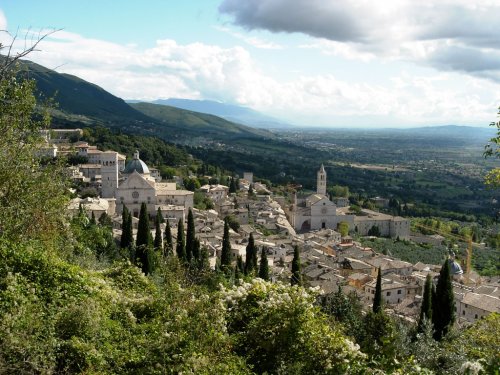
Assisi, Italy
I couldn’t drive further because I began crying spontaneously and intensely, with deep emotion sparked by a mysterious feeling of déjà vu that I had returned to a beloved and familiar place. Only after shedding many tears was I able to resume driving to my destination – the Ananda Spiritual Retreat Center in the Umbrian hills outside Assisi – where I stayed during my pilgrimage there.
The Ananda center had been founded by Swami Kriyananda, a prominent direct disciple of Paramahansa Yogananda, who in Autobiography of a Yogi referred to St. Francis as an “apostle of humility”. So, it seemed an ideal place for me stay as a “born-again Hindu” devotee of St. Francis.
According to Swami Kriyananda:
”St. Francis of Assisi was Paramhansa Yogananda’s “patron saint.” Yogananda had at least two visions of St. Francis that he spoke of — one during a visit to Assisi, Italy in 1936, and another at Mt. Washington that inspired his beautiful poem, “God, God, God.” Yogananda admired the renunciation and simplicity of St. Francis.”
After sleeping my first night at the Ananda center, the next day I drove into Assisi. With continuing déjà vu I walked through medieval streets of that lovely town experiencing a sweet and mysteriously familiar ambience. Then I visited the giant Basilica of Saint Francis, under which the great saint is entombed. Near the crypt containing his remains there were continuing Masses being celebrated consecutively in various languages for pilgrims from places worldwide.
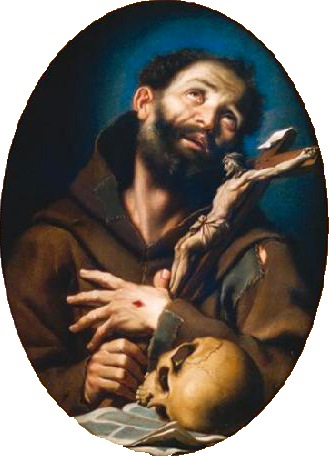
St. Francis of Assisi
As a secular Jew transformed to “born-again Hindu”, who spoke only English, I had never before participated in a Catholic mass. However, irresistibly I attended several consecutive masses in various languages which I didn’t understand. But my heart knew the pervasive sweet and familiar ambience which I had experienced outside the Basilica, and which had become intense for me near Franceso’s tomb beneath the Basilica. And I was compellingly drawn to it.
Eight hundred years after Saint Francis had walked in that lovely Umbrian town it seemed for me that it was everywhere still pervaded by his sweet life-force shakti; with its emanation being especially intense at the site of his entombed remains. Afterwards I unforgettably experienced that same familiar life-force emanation at other Assisi shrine places.
Hereafter I will tell you about three more memorable experiences of communing with the spirit of St. Francis in Italy.
Discovering the Porziuncola

Porziuncola within Basilica
One of the most profound of those experiences happened as I visited a tiny frescoed chapel outside Assisi called by Francesco Porziuncola [“the little portion”]. He and his early followers had restored it from a ruined condition to become first home of the Franciscan order. And it was Francesco’s favorite place on earth.
Here, he lived, fervently prayed, wrote his rule, created his order of friars minor and consecrated his friend Clara (Chiara), who became Santa Clara, founder of a female order dedicated to Franciscan ideals of holiness and poverty. Francis so loved this little place that he chose to die there.
In 1216, Francis had a legendary vision in the little chapel. After fervent and tearful prayers, a light filled the chapel and he saw above the altar Christ, the Virgin Mary and a company of angels. They asked him what he wanted for the salvation of souls. In response Francis requested that all those who might enter the chapel and contritely repent their sins be granted a pardon and remission of all such sins. Whereupon Francis was told by the heavenly host that his request was granted.
Thus, the Porziuncola was thereafter Papally blessed with “The Pardon of Assisi” so that those who enter and repentantly pray there are pardoned of their sins, and it has been proclaimed a ‘world holy place’.
Having paid respects to Saint Francis at the basilica where he is entombed, my next pilgrimage destination was the Porziuncola. But I went there unprepared for what I saw. In reading biographies of the saint I had focussed on his simplicity and humility and somehow missed description of the giant basilica which had enveloped his beloved tiny headquarters chapel.
I didn’t realize until then that by Papal order, three hundred fifty years after Francis’ death, the great Basilica of Santa Maria degli Angeli (Saint Mary of the Angels) was erected over the simple Porziuncola chapel – Franceso’s “little portion” – and that all its original outbuildings were demolished, except the simple cell where Francis died. So I felt a bit bewildered on approaching and entering the grandiose basilica – so inconsistent with Francis simple life and message – and wondered what he might say about it.
But I found my way to the tiny chapel which was situated directly beneath the basilica cupola. And after waiting in line with others, I was able to enter and sit in the tiny and simple Porziuncola. With renewed déjà vu, I immediately experienced an almost palpable aura of the saint’s supernal love, and spontaneously cried deeply and intensely. I was so overcome with emotion that I lost track of time.
On regaining my senses, I realized with a guilty conscience that I had overstayed my time there, while other pilgrims waited in line for a chance to enter, and perhaps to repent and be absolved of their sins. So in a highly “enshakticated” [love intoxicated] condition I slowly got up and walked out. With continuing déjà vu I strolled to the place there where Francis died on October 3, 1226. Then, still in an altered state of awareness, I returned to the Ananda center after one of the most memorable experiences of this lifetime.
Memory of that exquisitely simple little chapel and its aura of supernal Love has remained enshrined in my heart ever since my one visit there. Although I have never since returned to that holy Assisi place, which Saint Francis named and loved, my cherished memory of the Porziuncola was revived following a surprising and synchronistic ‘holy encounter’ and discovery – almost thirty years later – of a San Francisco Porziuncola Nuova. Never have I thereafter entered that San Francisco holy place without experiencing supernal love and tear laden emotion of devotion as in my pilgrimage to the Assisi Porziuncola.
An Unforgettable Experience at the Church of San Damiano
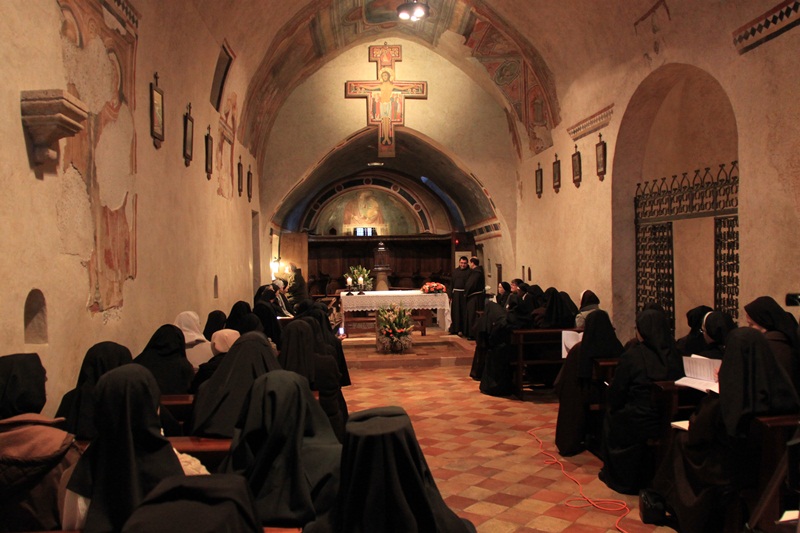
Church of San Damiano
Biographers of Saint Francis all agree that he had a transformative experience in an old and semi-abandoned church just below Assisi – the Church of San Damiano. There while he was enchantedly gazing at the painted wooden crucifix – a Byzantine image of the crucified Christ still alive on the cross – the silent voice of Jesus telepathically ‘spoke’ to Francesco, instructing him: “Francesco, Francesco, go and repair my house which, as you can see, is falling into ruins.” Thereafter, he devotedly began rebuilding San Damiano and other ruined churches, including the Porziuncola.
While repairing San Damiano, Francis often sang songs which spontaneously came to him. And he thereby attracted neighboring farmers and other visitors, presciently telling them that this ruined church would some day become a holy place attracting servants of God. And it did. As Francis predicted it was here that his friend Clara (Chiara), who became Santa Clara, founded Poor Ladies of San Damiano a female order and lived a cloistered life dedicated to Franciscan ideals of holiness and poverty.
Though Saint Francis took literally Jesus’ mystical message from the San Damiano crucifix, its true meaning proved metaphoric and profound. And by the end of his short lifespan, Saint Francis and his order had by their example inspired a renaissance of the Catholic Church from its then apparent corruption by worldly wealth.
Thus, as a pilgrim honoring Saint Francis, one of my most important planned destinations was the Church at San Damiano. At the Ananda Center I was urged to visit San Damiano for early morning mass then being celebrated by Franciscan Friars with beautiful ecclesiastic chanting. In following that advice, I was blessed with one of the most memorable and beautiful experiences of this lifetime.
Here is what happened.
My drive from the Ananda Center to San Damiano proved extraordinary. It was a sunny and beautiful spring morning, with azure blue sky and small white cumulous clouds. On turning off onto the quiet country road leading to my destination, the verdant landscape was ethereally beautiful – abounding with gorgeous blooming wild flowers. As I beheld this beauty it seemed as if I was enjoying a waking dream of being in heaven on earth. And again it invoked that sweet feeling of déjà vu which followed my first vista of the Assisi environs.
Thus, I arrived at the San Damiano chapel already in a somewhat ‘altered’ state of awareness, just as mass was about to begin. At the chapel portal I was surprised to see that the entire small sanctuary was already filled with people, and that I could not observe any remaining place to sit. So, as the chanting began, I stood at the chapel entry and began weeping with deep emotion of devotion. On observing me crying there, some compassionate worshippers squeezed together to make space for me to sit down.
Thereupon I sat down and continued crying with even greater emotional intensity. That is all I can remember of the mass.
Spontaneously, I went into a very deep state of meditation and lost all consciousness of what was happening. I don’t recall how long I was in that state. But when I awakened from it, there was not a soul in sight. I was seated all alone in the San Damiano chapel still in an ‘altered state of awareness’ and gazing at its painted wooden crucifix. * [see footnote].
Thereupon, a ‘silent voice’ from the crucifix telepathically said to me: “Ritorna a me!” – a message in Italian which I did not immediately understand.
For a while, my mind remained silent and my body remained still. When I finally reawakened to ‘normal’ body consciousness, I urgently needed to use a toilet. So I got up and left the chapel to find one.
But still there was not a soul in sight from whom I could get directions. So I wandered the empty corridors until soon seeing what appeared to be public rest rooms. But there were no signs with international gender symbols identifying them. Instead there were different Italian words on each door. But I couldn’t translate either of them. So, after momentary reflection, impelled by an urgent ‘call of Nature’ I entered what I guessed to be the men’s room. But I guessed wrong. Embarrassed, I made a quick exit, and used the other bathroom.
I left San Damiano wondering why God had addressed me in Italian, when I was so ignorant of that language that I couldn’t even find the men’s room.
Of course I soon learned – and will never forget – that “Ritorna a me!” meant “Return to me!” And I took it as a Divine message. Since then I have come to realize that, knowingly or unknowingly, every embodied human soul longs to return to its Divine Source. But that virtually all of us, including Ron, need frequent reminders of that eternal Truth.
Thus, I recall my extraordinary experience at San Damiano as such a reminder.
* This crucifix was an exact replica of the original crucifix worshipped by Saint Francis and Santa Clara, which for preservation had been previously removed to the Basilica of Santa Chiara in Assisi.
Excursion to Mount La Verna in Tuscany
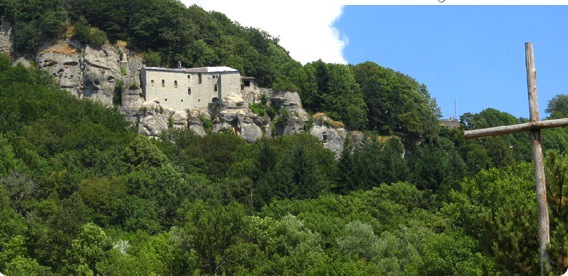
Mount La Verna Sanctuary
Notwithstanding my marvelous experiences of Saint Francis in and around Assisi, there remained on my pilgrimage itinerary an important place outside Assisi, Mount La Verna in Tuscany – where Francis became the first saint to receive the crucifixion stigmata of Christ. And also there remained for me great curiosity and a desire to solve the mystery of why – as a secular Jewish lawyer ignorant of Christian saints – I had developed a deep inner rapport with and love for Saint Francis, even before I had met my beloved Hindu Guruji, Shri Dhyanyogi Madhusudandas.
Before my midlife spiritual awakening, I had no inner visions and rarely remembered dreams. And even if I remembered them they were colorless and commonplace. But soon after my rebirth experience I had two repetitive extraordinary and mysterious visions or vivid dreams unlike any prior inner experience.
Twice, in semi-somnambulant states, I clearly perceived – like a slow motion ‘inner technicolor movie’ – a scene which I was viewing from a high aperture or window in a medieval building. * [see footnote]
I could not see any person at the aperture, but only experienced my consciousness being there and looking out. Below me were monks or friars clothed in simple robes or habits in a verdant open space midst trees surrounding the medieval structure from which ‘I’ was viewing them. Especially noteworthy was the extraordinary etherial light around that scene, which I immediately associated with Tuscany, the Italian state just North of Umbria, where I had visited in 1955.
So in 1992 I was anxious to visit Mount La Verna in Tuscany not only because Francis had his ultimate spiritual experience there, but also because of curiosity about those mysterious visions. However, because of my ignorance of the Italian language I was reluctant to journey alone from Umbria to La Verna. Then, synchronistically, a friendly multi-lingual Ananda center staff member familiar with La Verna and intermediate sites visited by Saint Francis compassionately offered to be my driver and tour guide for a full day’s excursion to those places.
The entire excursion proved a memorable experience in my already wonderful visit to Italy. With great interest, I saw various places known to Saint Francis. For example, we stopped at the town of Gubbio, where the saint is still venerated for legendarily confronting and taming a fierce wolf which was attacking townspeople and their livestock.
But for me our visit to the Mount Laverna sanctuary in the Tuscan Appenines proved the highpoint of our journey. Upon our arrival at La Verna, I immediately intuited – as we observed the grounds and structures there – that La Verna was the place in Tuscany which had appeared in my mysterious inner movie visions eighteen years earlier. Then, I meditated in a wooded area where, with renewed déjà vu, I again felt the supernally sweet presence of Saint Francis. As we departed from that lovely place, I felt great gratitude for our visit there, yet with continuing curiosity about the visions which had long preceded the visit.
Though I have ever since strongly felt that La Verna was the place which appeared in those early visions, their meaning remains an unsolved mystery. Perhaps in another lifetime I was at that place, when or after it was visited by Saint Francis. But I don’t know. And it’s probably not important that I know.
The Buddha taught that we should avert speculation which will not lead to edification. And speculation about imagined other life times can perhaps detract from fulfillment in this lifetime.
*I am describing these visions from memory, because I have not yet found any contemporaneous notes from over thirty years ago. After experiencing these visions I began regarding similar ‘inner movies’ as glimpses of other lifetimes.
Conclusion
My experiences of communion with Saint Francis of Assisi in places where he lovingly lived eight hundred years ago were memorably inspiring reminders of our human potential for humbly living a life of eternal love, even under difficult external circumstances. They strongly reinforced my continuing view of that great saint as an archetype to be emulated.
For an experience of the inspiring ambience bequeathed to us by Franceso’s life of love and humility, I highly recommend your viewing “Brother Sun, Sister Moon”, a 1972 film, masterfully directed by Franco Zeffirelli. Based on the life and legend of Saint Francis of Assisi, this two hour film is exceptionally beautiful and inspiring.
Love is Our New Religion
“There is only one religion,
the religion of Love.”
~ Sathya Sai Baba
“Our purpose is process –
Metamorphic process.
Gleaning meaning in matter,
We learn all that matters –
We learn all that matters is LOVE!”
~ Ron Rattner, Sutra Sayings
“Love is joyous consciousness.
That consciousness is the Creator,
and it is out of Love and joy
that (S)He creates.”
~ Swami Amar Jyoti

Ron’s Introduction
Knowingly or unknowingly, we are awakening to our true Essence and nature, which is LOVE. As we awaken we are co-creating an ever better reality – as we intend, intuit, and imagine it to be.
Spiritual author and teacher Brian Piergrossi has beautifully captured and communicated our re-awakening to LOVE with his poem “Love is the New Religion” .
Thanks to Aluna Joy Yaxkin and harpist Peter Sterling,
Brian’s powerful message is displayed with beautiful multimedia, photography and music on a You Tube video.
Here is the video version:
Here is an edited version of Brian’s poem:
Love is the New Religion
On the surface of our world right now
There is war, violence, and craziness
And things may seem dark.
But calmly and quietly
At the same time
Something is happening underground.
An inner revolution is taking place
And certain individuals
Are being called to a higher light.
It is a silent revolution
From the inside out
From the ground up.
This is a global co-operation
That has sleeper cells in every nation.
It is a planetary Spiritual Conspiracy.
You won’t likely see us on T.V.
You won’t read about us in the newspaper.
You won’t hear from us on the radio.
We don’t seek glory.
We don’t wear any uniform. We come in all shapes and sizes, colors and styles.
We are in every country and culture of the world
In cities big and small, mountains and valleys
In farms and villages, tribes and remote islands.
Most of us work anonymously
Seeking not recognition of name
But profound transformation of life.
Working quietly behind the scenes
You could pass by one of us on the street
And not even notice.
We go undercover
Not concerned for who takes the final credit
But simply that the work gets done.
Many of us may seem to have normal jobs.
But behind the external storefront
Is where the deeper work takes a place.
With the individual and collective power
Of our minds and hearts
We spread passion, knowledge, and joy to all.
Some call us the Conscious Army
As together
We co-create a new world.
Our orders come from the Spiritual Intelligence Agency
Instructing us to drop soft, secret love bombs
when no one is looking.
Poems ~ Hugs ~ Music ~ Photography ~ Smiles ~ Kind words Movies ~ Meditation and prayer ~ Dance ~ Websites Social activism ~ Blogs ~ Random acts of kindness…
We each express ourselves
In our own unique ways
With our own unique gifts and talents.
“Be the change you want to see in the world”
That is the motto that fills our hearts.
We know this is the path to profound transformation.
We know that quietly and humbly
Individually and collectively
We have the power of all the oceans combined.
At first glance our work is not even visible.
It is slow and meticulous
Like the formation of mountains.
And yet with our combined efforts
Entire tectonic plates
Are being shaped and moved for centuries to come.
Love is the religion we come to share
And you don’t need to be highly educated
Or have exceptional knowledge to understand it.
Love arises from the intelligence of the heart
Embedded in the timeless evolutionary pulse
Of all living beings.
Be the change you want to see in the world.
Nobody else can do it for you.
Yet don’t forget, we are all here supporting you.
We are now recruiting.
Perhaps you will join us
Or already have.
For in this spiritual conspiracy
All are welcome, and all are loved.
The door is always open.
Invocation
May the Universe empower us to realize together our common dream for an ever better world – where LOVE is our common religion, blessing everyone everywhere.
And so shall it be!
Transcending Transcendence?
~ Ron’s Memoirs
“The goal is not to lose oneself in the Divine Consciousness.
The goal is to let the Divine Consciousness
penetrate into Matter and transform it.”
~ Sri Aurobindo – The Mother 15: p.191
“Cosmic consciousness is
infinite evolutionary impetus in each of us.”
~ Ron Rattner, Sutra Sayings
“As we experience our universality,
we transform our reality.”
~ Ron Rattner, Sutra Sayings
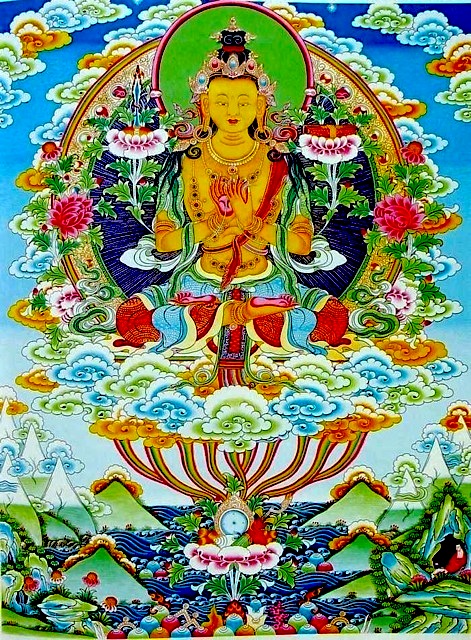
Maitreya Bodhisattva
Transcending Transcendence
My miraculous “sight seeing” trip with Dhyanyogi, and subsequent experiences, inspired ever increasing faith in his saintly good will and yogic powers. But questions arose for me about his Hindu path.
In writings introducing his path to Americans, Guruji said that Kundalini Maha Yoga was not a religion but a spiritual practice bringing “lasting inner peace and happiness to individuals of any belief or religious affiliation.” But his prescribed spiritual practices mostly included Sanskrit prayers and mantras associated with Hinduism, in addition to daily meditations.
At first I was uncomfortable reciting Sanskrit prayers and mantras which I didn’t understand, except for the Ram mantra with which I have always felt deep affinity. But intuitively I relied on Guruji’s extraordinary being and benevolence, and on his assurances that initiates would enjoy “a happy life”. So gradually I became more and more engaged in these practices, trusting that they would help me live a happy life.
Then, during a public meditation program, Guruji said these sanskrit practices would lead us to “the spiritual goal”. And I wondered: “what spiritual goal?” Amazingly, though I was still then an ‘uptight’ skeptical lawyer, I had taken an initiation from an unknown Hindu guru and was repeating his esoteric Sanskrit prayers and mantras not knowing what they meant or that their purpose was to achieve some “spiritual goal”.
So, after the meditation program, I asked others about this “spiritual goal”. I was told that the object of Hindu practices was to achieve “mukti” or “moksha” or “self-realization”; that the kundalini purification process, viz. the “evolutionary process taking place in [my] nervous system”, would some day in some lifetime lead to a state of Divine illumination where the Self, soul, or “Atman” would experience its Oneness with “Brahman” [Supreme Reality] – the pinnacle of human experience. Only then did I begin considering these ideas of “self realization”.
Though Guruji’s assurance of our finding lasting peace and happiness was appealing, I hadn’t consciously been drawn to him by this assurance but by a deep intuitive heartfelt connection. Before meeting Guruji I was not ‘goal oriented’. Instinctively hesitant to pursue materialistic societal goals, I was mostly inner – not outer – directed. But never before had I considered any inner ‘goals’.
In the late 1950’s I had been deeply influenced on reading “The Sane Society” by then prominent psychotherapist Erich Fromm, about the pathology of ‘normalcy’ in our materialistic society. Fromm suggested that Western society as a whole was lacking in sanity; that the inequities and disharmonies of the entire society were pathological, not just the mental illnesses of people therein. Fromm’s essay had confirmed and enhanced my instinctive reluctance to selfishly follow materialistic societal goals.
So, in becoming a lawyer and throughout my professional career, my main motivation was to help others; it was not to become rich or famous. Long before my spiritual awakening, I had a deep inner instinct to pursue social justice causes, with considerable sensitivity to the “insanity and iniquity of inequity in our society”.
But, with the Yosemite inner experience of “ten thousand suns” I realized that beyond my instinct for social justice was an extraordinarily intense longing for the Divine – to return from this crazy world back to God, back to Ram. However, not until hearing Dhyanyogi’s teachings about a spiritual “goal”, did I consider pro-actively seeking such an inner goal.
Though initially it seemed desirable to aspire to “self realization” or “enlightenment”, I was unable to relate experientially to those illumined states as ascribed to rare beings like Gautama Buddha. So, I was never clear about what to “seek” until, ultimately, I stopped seeking it, whatever it was.
After considerable reflection, I abandoned goal oriented spiritual seeking, and intuitively began with more and more heartfelt faith to surrender to the Infinite – “to let go, and go with the flow” – and to “leave it to the Lone Arranger.” * Perhaps, I transcended transcendence aspirations.
Inspired by the Buddhist Bodhisattva ideal of altruistically helping all beings end their sufferings, I stopped trying to be beyond this world, but rather to be in it in a way which might help all life everywhere. And I ceased regarding “enlightenment” as a “goal” but rather as an endless evolutionary process.
Experientially, I had realized that ‘the Kingdom of Heaven’, Buddha nature, and Love, were the Essence of everything in our phenomenal “reality”. And my core spiritual motivation became and remains:
“Infuse us, enthuse us, and use us, to bless all Life as LOVE.”
But paradoxically I have learned from experience that we cannot change others, only ourselves; that by furthering our own evolution we help elevate humanity’s common consciousness and thereby subtly help others. So, I consider it my responsibility to aspire to be the change I wish to see in the world, with the intention and dedication of so helping everyone everywhere.
And in this process, as Guruji promised, with unspeakable gratitude I am now enjoying “a happy life” beyond anything that I could have imagined when I received a shaktipat initiation in 1978.
*Footnote
Many ideas about “enlightenment” are in articles posted elsewhere on SillySutras.com. E.g. see https://sillysutras.com/?p=2925 and https://sillysutras.com/?p=1180
“The Gift of Giving”
~ a Synchronicity Story with Quotations
‘It is more blessed to give than to receive.’
~ Acts 20:35 (Paul quoting Jesus)
“The wise man does not lay up his own treasures.
The more he gives to others, the more he has for his own.”
~ Lao Tzu
“For in truth it is life that gives unto life –
while you, who deem yourself a giver,
is but a witness.”
~ Kahlil Gibran, The Prophet
“You can give without loving,
but you can never love without giving.”
~ Robert Louis Stevenson and/or
~ Victor Hugo, Les Misérables
“Lovers are givers, not getters.”
“Life is for giving, not getting.”
~ Ron Rattner, Sutra Sayings
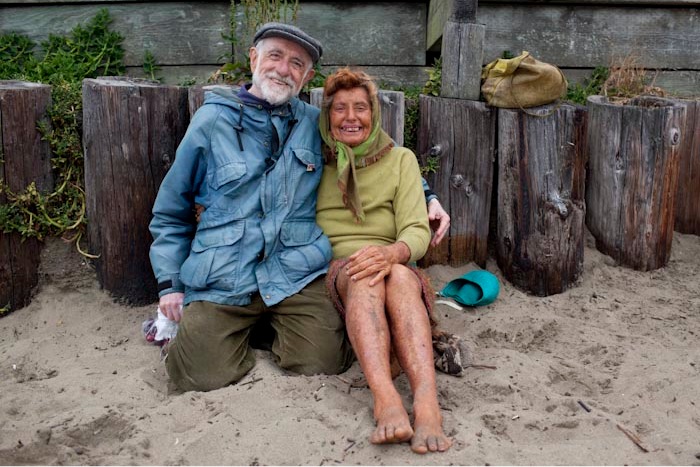
Ron Rattner and Carol Schuldt at Aquatic Beach, 2012
“The Gift of Giving”
Here is another amazing synchronicity story about my now 79 year old friend Carol Schuldt, one of the most unforgettable people I’ve ever known.
Carol is an extraordinarily intuitive free spirit, with her own unique path of communing with Nature while surfing, swimming, sunning, hiking, biking, and gardening, and helping troubled souls – especially young people. Though raised Catholic, she has never knowingly followed any prescribed Western or Eastern spiritual path. Because of her great generosity, especially toward needy young people, Carol is sometimes known as the “Mother Teresa of the Sunset District”.
We met long ago at Aquatic Beach on San Francisco Bay (across from Ghirardelli Square), where Carol often comes to escape ocean fog and swim in the sun. Since then, we’ve had innumerable synchronistic encounters and exchanged many “miracle” stories about our lives. [I’ve posted other synchronicity stories about Carol, which are linked below as “related posts”.]
As I write, I have just returned from another magical encounter with Carol at Aquatic Beach, on a cold December 29, where Carol shared with me a wonderful synchronicity story about her experiences earlier today and yesterday.
Here it is:
Carol swims or surfs in the ocean or Bay almost every day. But, on rare days when she can’t swim because of inclement or cold weather, Carol sometimes browses and shops at the main Goodwill resale store near downtown San Francisco.
Yesterday, was one of those rare days when it was too cold and rainy for Carol to swim. So she drove her old truck toward the Goodwill store, and parked several blocks away in front of a community garden on Fell Street. After walking to the Goodwill store and shopping, Carol was returning to her parked truck when suddenly she urgently needed to urinate. There were no available public restrooms, so she had to relieve herself in a nearby empty lot. Afterwards, to her chagrin and embarrassment, Carol discovered that she had mistakenly peed on an elderly homeless man’s tent.
In remorse, Carol opened the tent entry flap and apologized to its homeless occupant, telling him “I’m very sorry, but I just peed on your tent”. Then Carol pulled a twenty dollar bill out of her wallet, and tendered it to the homeless man, saying: “Here, please take this.” After looking at Carol (who is sometimes mistaken for a ‘street person’ or ‘bag lady’ because of her unusual attire and appearance) he replied: “No baby, I can’t take it.”
But Carol insisted he take the twenty dollar bill, emphatically repeating that she had just peed on his tent. So he relented, and took the money with a broad smile. Her guilty feelings assuaged, Carol then drove off in her old truck.
This morning it was again cold and inclement in San Francisco. So Carol decided to return again to the Goodwill store. As she again parked her old truck on Fell Street near the community garden, a small moving van stopped after its driver observed her. The driver got out of the van and offered to Carol the load he was transporting, asking her to take it onto her truck. On his van Carol saw many valuable garden tools and other artifacts in good condition which she could use in her organic garden, plus a new volley ball which her son Pete could use. So Carol accepted the van driver’s offer, and relieved him of responsibility to dispose of his load, by transferring it to her truck.
Thereupon, on seeing that the morning overcast was lifting to reveal patches of blue sky, Carol spontaneously decided to drive to Aquatic Beach instead of walking to the Goodwill store. At the beach, Carol swam in very cold water, then dressed and was sitting and warming herself in sunshine when a family group of tourists walked onto the beach and looked at her.
Jovially pointing at Carol, the family’s father exclaimed to his companions, “She’s having fun. There’s a happy person.” Then after walking to the shore with a child, he came back to Carol and offered her a twenty dollar bill. Carol – who is economically well off – told him “I can’t take that.” But he insisted. So Carol reluctantly accepted his twenty dollar gift.
Thus, just a day after she had spontaneously given a twenty dollar bill to a reluctant homeless man, Carol drove home from Aquatic Beach with another twenty dollar bill given her by a stranger after she reluctantly accepted it. And her old truck was filled with valuable garden equipment given to her by another stranger near the very same place where she peed on the homeless man’s tent.
Moral of this story:
“It is in giving that we receive.”
A Brain Scientist’s ‘No Brainer’ NDE
“The brain does not create consciousness,
but consciousness created the brain,
the most complex physical form on earth, for its expression.”
~ Eckhart Tolle
I regard consciousness as fundamental.
I regard matter as derivative from consciousness.
We cannot get behind consciousness.
Everything that we talk about, everything that we regard as existing,
postulates consciousness.
~ Max Planck, Nobel laureate physicist, as quoted in The Observer (25 January 1931)
“The very study of the physical world leads to the conclusion that
consciousness is an ultimate reality and,
all the possible knowledge, concerning objects
can be given as its wave function”
~ Eugene Wigner, Nobel laureate physicist and co-founder of quantum mechanics

Introduction.
For millennia mystics and seers have realized experientially that our space/time/causality reality is but a play of consciousness; that all impermanent appearances, all apparent forms and phenomena – including human brains – are but holographic projections of timeless Universal Awareness.
But very few scientists have shared this revelatory mystical world view. Most scientists do not regard as “real” that which is beyond perception and conception.
Rather than recognizing consciousness as the ultimate and eternal Source of our reality, reductionistic and materialistic mainstream science says that brains generate consciousness, and that we see via our brains.
However, there have been innumerable published reports of near death and out of body experiences and other mystical experiences which contradict this mainstream brain hypothesis. (*See footnote re Near Death Experiences [NDE’s].) Nonetheless, until now most brain scientists have dismissed these reports as untrustworthy “anecdotal” evidence. Rarely have mainstream brain scientists transcended their mistaken materialistic paradigm. But there have been noteworthy exceptions. (see e.g. Atlantic Monthly: The Science of Near-Death Experiences.)
Dr. Eben Alexander
Thus, in October 2012 Dr. Eben Alexander, a neurosurgeon who has taught at Harvard Medical School, went public with an autobiographical account of a life changing dramatic and vivid near death experience (NDE) of what he called “heaven” while he was in a week-long comatose state with a non-functional brain neocortex. (His best-selling first book, ”Proof of Heaven”, was published by Simon and Schuster on October 23, 2012.)
Dr. Alexander reported being told in “heaven”:
“‘You have nothing to fear. There is nothing you can do wrong.’ The message flooded me with a vast and crazy sensation of relief.”
He has written that prior to his NDE he did not believe in such experiences, and ‘scientifically’ dismissed them.
“As a neurosurgeon, I did not believe in the phenomenon of near-death experiences. I grew up in a scientific world, the son of a neurosurgeon. I followed my father’s path and became an academic neurosurgeon, teaching at Harvard Medical School and other universities. I understand what happens to the brain when people are near death, and I had always believed there were good scientific explanations for the heavenly out-of-body journeys described by those who narrowly escaped death.”
“According to current medical understanding of the brain and mind, there is absolutely no way that I could have experienced even a dim and limited consciousness during my time in the coma, much less the hyper-vivid and completely coherent odyssey I underwent.”
“There is no scientific explanation for the fact that while my body lay in coma, my mind—my conscious, inner self—was alive and well. While the neurons of my cortex were stunned to complete inactivity by the bacteria that had attacked them, my brain-free consciousness journeyed to another, larger dimension of the universe: a dimension I’d never dreamed existed and which the old, pre-coma me would have been more than happy to explain was a simple impossibility.”
Raised as a Christian, Dr. Alexander used the religious concepts of “God” and “heaven”, to describe his extraordinary experience.
“Communicating with God is the most extraordinary experience imaginable, yet at the same time it’s the most natural one of all, because God is present in us at all times. Omniscient, omnipotent, personal-and loving us without conditions. We are connected as One through our divine link with God.”
Apart from referring to God, he also identified unconditional Love as the the ultimate Reality and “basis of everything” that exists.
“Love is, without a doubt, the basis of everything. Not some abstract, hard-to-fathom kind of love but the day-to-day kind that everyone knows-the kind of love we feel when we look at our spouse and our children, or even our animals. In its purest and most powerful form, this love is not jealous or selfish, but unconditional. This is the reality of realities, the incomprehensibly glorious truth of truths that lives and breathes at the core of everything that exists or will ever exist, and no remotely accurate understanding of who and what we are can be achieved by anyone who does not know it, and embody it in all of their actions.”
With newfound openness to “anecdotal” evidence, Dr. Alexander now expresses optimism that as science and mysticism ever more agree, humankind will evolve to wonderful new states of being.
And so may it be!
Footnote
*Near Death Experiences [NDE’s].
The term ‘Near Death Experience’ [NDE] was coined in 1975 by Raymond A. Moody, Jr., PhD, MD, in his book Life After Life which sold over thirteen million copies worldwide. Since then numerous NDE accounts have been published and discussed in mainstream media, on the internet, in films and videos, and in magazines and books. Many spiritually inspiring NDE stories have been published and researched by the International Association For Near-Death Studies [IANDS] and others. So NDE’s have become widely considered, especially by those who claim to have experienced them. And some non-materialist scientists cite NDE’s as evidence that consciousness survives physical death. For millions of people NDE’s, and other extraordinary mystical experiences, have proven to be spiritually inspirational, and transformative events, diminishing or ending fear of death and encouraging a newly open, trusting and loving lifestyle. (see e.g. Atlantic Monthly: The Science of Near-Death Experiences.)
Think Before You Speak
“All that we are is the result of what we have thought:
it is founded on our thoughts, it is made up of our thoughts.
If a man speaks or acts with an evil thought, pain follows him,
as the wheel follows the foot of the ox that draws the carriage.”
~ Buddha
“A man is but the product of his thoughts; what he thinks, he becomes.”
~ Gandhi
“Nothing’s either good or bad, but thinking makes it so.”
~ Shakespeare
This world is wrought with naught but thought.
~ Ron Rattner, Sutra Sayings
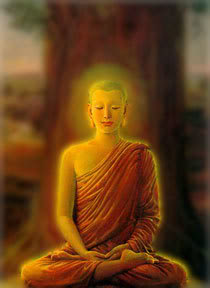
Think Before You Speak:
The thought manifests as the word.
The word manifests as the deed.
The deed develops into the habit.
The habit hardens into the character.
The character gives birth to the destiny.
So, watch your thoughts with care
And let them spring from love
Born out of respect for all beings.
~ The Buddha, as paraphrased by Mahagosananda
Synchronicity Story: A Spiritual Experience on Bernal Heights
“If you could only sense how important you are to the lives of those you meet; how important you can be to the people you may never even dream of. There is something of yourself that you leave at every meeting with another person.”
~ Fred Rogers
“When you meet anyone, remember it is a holy encounter. As you see him, you will see yourself. As you treat him, you will treat yourself. As you think of him, you will think of yourself. Never forget this, for in him you will find yourself or lose sight of yourself.”
~ A Course in Miracles (ACIM)
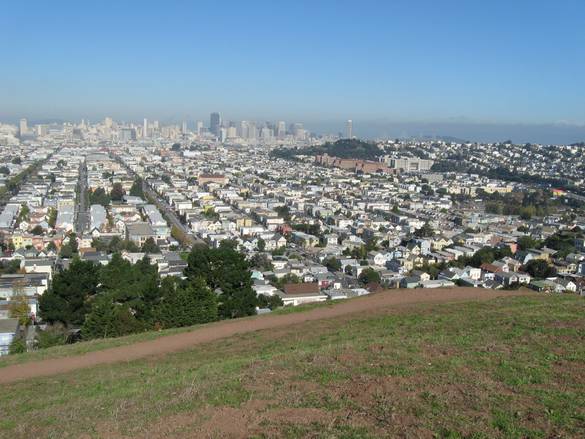
Bernal Heights view
Lately, I have been blessed with ever more magical moments and with ever increasing gratitude for this precious and lucky life. Usually these magical moments have happened synchronistically and unexpectedly. And often they’ve involved spiritual experiences with people, creatures or Nature, which I call “holy encounters”.
Just before the recent solstice holidays, I was blessed with a magical visit to a beautiful San Francisco view place which I had never before seen. And there I met a lovely man, Daniel Raskin, who shared with me a haunting story (which follows) of his unforgettable spiritual experience in a remote Utah desert canyon.
Here’s what happened, and the story Daniel told me:
I moved from Chicago to San Francisco in 1960, attracted by San Francisco’s climate, physical beauty and ambiance. Within its boundaries are more than fifty hills, several islands, and significant stretches of Pacific Ocean and San Francisco Bay.
So, while living in San Francisco I have visited and enjoyed almost all of its best known view places. But until recently I never had known about or seen the spectacular view from atop Bernal Heights a hilly neighborhood above San Francisco’s outer Mission and Bay View districts.
Then, just before Christmas, I was invited to attend a beautiful holiday dinner party hosted by Shelley Cook, a very talented and intuitive massage therapist who has been skillfully helping heal and realign my body since it suffered a painful lower back yoga injury.
At the party there were many lovely artistic people, all much younger than me. One of the other guests, Audrey Daniel, a professional photographer/videographer, told me she had lived for many years in San Francisco’s Bernal Heights district, which she regarded as San Francisco’s most charming and typical neighborhood – like a village within the city. Whereupon, realizing that I had never yet visited Bernal Heights during my 50+ years as a San Franciscan, I became curious about seeing what Audrey was describing.
My curiosity was soon satisfied synchronistically by The Lone Arranger, my ‘appointments secretary’.
A few days after the party, at Shelley’s request, I unexpectedly rescheduled my regular afternoon appointment with her to morning, so she could accommodate some people from Santa Cruz who’d just been injured in an auto accident.
Upon finishing our morning massage therapy session, Shelley had extra time before her afternoon appointments. Generously, she offered to show me a nearby Vedanta healing center and shrine which she had long been urging me to visit. So we went to the shrine.
There, as I gazed at an image of Ramakrishna Paramahamsa – a nineteenth century Hindu saint with whom I have long felt special affinity – I experienced a deep Divine mood, and cried copious tears of devotion.
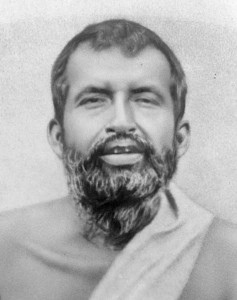
Ramakrishna Paramahamsa
Thereafter, when Shelley and I left the shrine, it was lunch time. And instead of returning home to eat, I unexpectedly went with Shelley to a restaurant which she recommended. At first she suggested a nearby Asian restaurant, but then she suddenly intuited that we would probably more enjoy going to a place on Bernal Heights.
So, four days after hearing from Audrey Daniel about the Bernal Heights district, I visited that area for the first time in my life, and there enjoyed a delicious Mexican lunch with Shelley. After we ate and before returning to her studio, Shelley urged me to hike atop Bernal hill to enjoy the magnificent panoramic view of San Francisco, instead of taking my usual daily walk by the Bay.
So, still in spiritual mood from my experience at the Ramakrishna Vedanta shrine, I walked up steep streets to the base of Bernal hill. There I approached the first person I encountered, seeking directions to the hilltop trail.
But instead of a quick encounter about directions, we had an extended dialogue. It was Daniel Raskin, with whom I enjoyed a long spiritual chat and experienced a ‘holy encounter’, before we parted and I beheld the spectacular panoramic view from atop Bernal Hill.
Synchronistically, Daniel identified himself as a photographer living in the Bernal Heights vicinity, like Audrey the photographer responsible for my curiosity about that neighborhood. And when I mentioned Audrey, Daniel said he had participated and appeared in her documentary film The Owls of Bernal Hill.
As we chatted, I told Daniel of my interest in mysterious spiritual synchronicities. Whereupon, he shared with me a wonderful story of an unforgettable spiritual experience. Here is Daniel’s story as he wrote it for a diary in 1998, just after it happened:
A Spiritual Experience
By Daniel Raskin *
July 15, 1998, Cottonwood Point, Arizona
Sierra Club Trip: Locating Petroglyphs
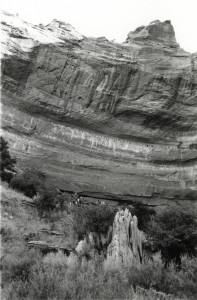
Utah Box Canyon
Today we visited the end of a box canyon where there were complex and intriguing ancient petroglyphs and small ruins. After breakfast we drove a short way to our trailhead and hiked a few miles along a sandy path. The plants were mostly a bluish
aromatic sage; also juniper, cacti, local grasses and, here and there, a late blooming flower. The sky was perfectly clear, deep blue, and the sun fierce. Most of the hike was in full sun; the temperature in the nineties by ten or eleven.
The end of the canyon was a spectacular place, a high semi-circular vertical cliff. It was concave and beautifully banded, brown, light brown, reddish brown and yellow. A broad waterless wash wove through the flat valley floor. There, in the
shade of the canyon, oaks and plants with red berries grew.
As soon as I got into the shade of the canyon walls, I began to breathe rapidly. I did not feel I had over-exerted myself, and did not understand why I was breathless. I began to feel slightly nauseous, faint and dizzy. I also felt very moved by the beauty surrounding me. I began to feel very emotional. My heartbeat was rapid and my breath uncontrollably fast and deep. I began to feel like I had taken LSD.
I sat down. My condition intensified. I began to cry, copious tears. I was simultaneously relieved, frightened and confused. My thoughts and feelings wandered freely. As I continued to cry, I felt over-joyed to be alive. I felt blessed to enjoy the relative security of my middle class existence. I thought about my partner Ann. I thought about her ovarian cancer. It almost killed her, but now she is healthy again and stronger in new ways. I thought about Jesse, my twenty-one year old, and how he is now thriving after a difficult adolescence. I thought about Sam, my sixteen year old. He has survived a risky and chaotic early adolescence, and is stronger and more mature. I felt my love, my powerful love for my family. All this time I was crying and breathing deeply.
I thought about the miracle of being alive, of experiencing existence in the midst of infinite eternity. What explains my chance to experience life? Who or what, ultimately, gave me and all of us this miraculous gift?
As I thought and cried, I slowly began to calm down. My breath slowed. After a while I felt stable enough to get up. I took photographs of the canyon and the beautiful oaks and wild currents growing there. Then I joined the group. They had
dispersed about the headwall to view the great array of petroglyphs. There were animals, human figures, designs and scenes pecked into the rock. The most impressive was a figure of a one-legged person. People with deformities were sometimes holy people in Native American cultures.
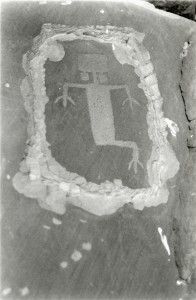
After looking at the rock art I investigated the remains of a kiva. A coyote had made a lair in its recesses. I found a small rodent’s jaw. I climbed down to the canyon floor. Datura, a hallucinogenic plant was growing there. I wondered: “am I in a sacred place?” After a while we left the canyon, had lunch, visited more rock art sites and returned to camp. I felt light-headed for several hours.
What happened to me? Did I become delirious from the heat? Was I freaked out by the rigors of this trip, lonely for my family? Maybe. But why did this happen today, rather than on another hot, hard working day?
And, why did this happen in a place with a petroglyph of a one-legged person, a kiva and hallucinogenic plants growing?
I’d like to say I had a vision, if saying that didn’t feel arrogant and presumptuous. Who knows? Fortunately, life is full of mysteries.
After returning home: I shared my experience with Ann. She said that I had had a spiritual experience about the gift of life and the power of love, as she had had when she was sick with cancer.
* Daniel Raskin is a retired San Francisco preschool teacher and photographer.
Utah Box Canyon
Today we visited the end of a box canyon where there were complex and intriguing ancient petroglyphs and small ruins. After breakfast we drove a short way to our trailhead and hiked a few miles along a sandy path. The plants were mostly a bluish
aromatic sage; also juniper, cacti, local grasses and, here and there, a late blooming flower. The sky was perfectly clear, deep blue, and the sun fierce. Most of the hike was in full sun; the temperature in the nineties by ten or eleven.
The end of the canyon was a spectacular place, a high semi-circular vertical cliff. It was concave and beautifully banded, brown, light brown, reddish brown and yellow. A broad waterless wash wove through the flat valley floor. There, in the
shade of the canyon, oaks and plants with red berries grew.
As soon as I got into the shade of the canyon walls, I began to breathe rapidly. I did not feel I had over-exerted myself, and did not understand why I was breathless. I began to feel slightly nauseous, faint and dizzy. I also felt very moved by the beauty surrounding me. I began to feel very emotional. My heartbeat was rapid and my breath uncontrollably fast and deep. I began to feel like I had taken LSD.
I sat down. My condition intensified. I began to cry, copious tears. I was simultaneously relieved, frightened and confused. My thoughts and feelings wandered freely. As I continued to cry, I felt over-joyed to be alive. I felt blessed to enjoy the relative security of my middle class existence. I thought about my partner Ann. I thought about her ovarian cancer. It almost killed her, but now she is healthy again and stronger in new ways. I thought about Jesse, my twenty-one year old, and how he is now thriving after a difficult adolescence. I thought about Sam, my sixteen year old. He has survived a risky and chaotic early adolescence, and is stronger and more mature. I felt my love, my powerful love for my family. All this time I was crying and breathing deeply.
I thought about the miracle of being alive, of experiencing existence in the midst of infinite eternity. What explains my chance to experience life? Who or what, ultimately, gave me and all of us this miraculous gift?
As I thought and cried, I slowly began to calm down. My breath slowed. After a while I felt stable enough to get up. I took photographs of the canyon and the beautiful oaks and wild currents growing there. Then I joined the group. They had
dispersed about the headwall to view the great array of petroglyphs. There were animals, human figures, designs and scenes pecked into the rock. The most impressive was a figure of a one-legged person. People with deformities were sometimes holy people in Native American cultures.
After looking at the rock art I investigated the remains of a kiva. A coyote had made a lair in its recesses. I found a small rodent’s jaw. I climbed down to the canyon floor. Datura, a hallucinogenic plant was growing there. I wondered: “am I in a sacred place?” After a while we left the canyon, had lunch, visited more rock art sites and returned to camp. I felt light-headed for several hours.
What happened to me? Did I become delirious from the heat? Was I freaked out by the rigors of this trip, lonely for my family? Maybe. But why did this happen today, rather than on another hot, hard working day?
And, why did this happen in a place with a petroglyph of a one-legged person, a kiva and hallucinogenic plants growing?
I’d like to say I had a vision, if saying that didn’t feel arrogant and presumptuous. Who knows? Fortunately, life is full of mysteries.
After returning home: I shared my experience with Ann. She said that I had had a spiritual experience about the gift of life and the power of love, as she had had when she was sick with cancer.
* Daniel Raskin is a retired San Francisco preschool teacher and photographer.
******
Do you agree (as I do) with Daniel’s partner Ann that he “had a spiritual experience about the gift of life and the power of love”?
And didn’t Daniel’s spontaneously copious tears express more eloquently than any words the heartfelt depths of his joy and gratitude for this blessed life?
Ron’s moral of the story:
Daniel’s deep spiritual experience, shows us that we don’t need religious rituals, beliefs or dogma to experience Divinity; that, beyond religion, our grateful communion with Nature can be an equally powerful spiritual path.